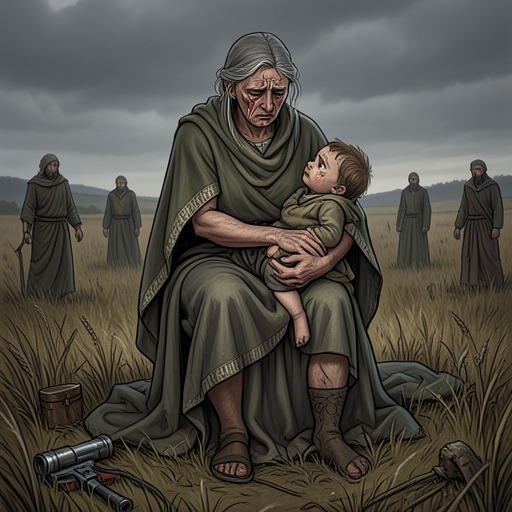
Sorrow’s death and secret burial
Tess of the d'UrbervillesSorrow’s death and secret burial bring the novel’s conflict between maternal love and institutional religious authority to a quiet, sharply defined crisis. After the infant dies, Tess worries whether the baptism she performed was doctrinally sufficient and whether he can receive a Christian burial. The vicar assures her that the rite will count, yet refuses the burial she requests; Sorrow is carried to the churchyard at night and interred in its shabby, excluded corner. Tess answers that exclusion with a small cross and flowers, making a private act of care the episode’s most enduring rite.
The infant’s death and Tess’s response
Sorrow dies in the blue of morning, his brief life described through the image of a fragile soldier and servant whose campaign against sin, the world, and the devil was bound to be short. When the other children wake, they cry and ask Tess to have another pretty baby. Their response registers the loss in the immediate language of the household, while the narration measures the child’s life against a world of time he never had the chance to know.
Tess remains calm after the death, a composure that has been with her since the christening. In daylight, her earlier fears for the child’s soul seem exaggerated to her. She reasons that if Providence will not ratify an act of approximation, she does not value the kind of heaven that would be withheld for that irregularity, whether from her or from her child. Her response does not erase grief; it shows her refusing to accept that ecclesiastical technicalities can make a loving act spiritually worthless.
The narration calls Sorrow an unwanted, intrusive presence, a child born outside social law, and stresses the narrow scale of his existence: the cottage interior was his universe, the week’s weather his climate, and new-born babyhood the whole of human life he knew. This compressed account makes the burial dispute more than a question of procedure. The child’s short life is already over, yet social and religious classifications continue to determine how his death will be publicly marked.
Tess seeks recognition for the baptism
Tess has performed the emergency baptism herself, and after Sorrow’s death she turns to the question of whether it is sufficient to secure Christian burial. The parish parson is new to the area and does not know her. She goes to his house after dusk but cannot summon the courage to enter; only by chance does she meet him as he returns home, after she has turned away. In the gloom, she finds it easier to speak freely.
She tells the vicar about the baby’s illness and the improvised rite, then asks whether its effect will be the same as if he had baptized the child. He answers that it will. His response is presented as a conflict between his professional and ecclesiastical habits and his human feeling: he had reason to regard the rite as an improperly performed task, but Tess’s dignity and tenderness move him to answer compassionately. The scene grants her request for spiritual reassurance even as it exposes how dependent that reassurance is on the judgment of an individual clergyman.
Tess immediately asks whether the vicar will give Sorrow a Christian burial. That request brings a different barrier into view. The vicar had gone to the house after nightfall intending to perform the rite, but he had been refused admission by Tess’s father, not by Tess. Unaware of this distinction, he cannot use necessity to justify the baptism’s irregular administration. When Tess presses him to do it just once, he insists that he must not, although he also tells her that the refusal will make no difference to the child. The answer consoles her in one sense while leaving the practical refusal intact.
The burial in the churchyard
That night, Sorrow is taken to the churchyard in a small deal box beneath an old woman’s shawl. The burial takes place by lantern-light, with the sexton paid a shilling and a pint of beer. The grave is in a neglected corner where nettles grow, a place assigned to unbaptized infants, notorious drunkards, suicides, and others treated as conjecturally damned. The scene’s concrete arrangements make exclusion visible: Sorrow is buried in consecrated ground, but not among those whose status is socially unquestioned.
The burial follows the vicar’s refusal, not because Tess accepts that the child is unworthy of care, but because the institution’s categories have set the terms of his resting place. The episode does not present the churchyard’s distinction as a simple reflection of Tess’s belief. She has already challenged the idea that an irregularity in baptism could determine the child’s spiritual fate; now the burial practice assigns him a marginal place all the same.
Tess’s private memorial
Tess returns to the churchyard one evening when she can enter unseen. She makes a small cross from two laths and a piece of string, binds it with flowers, and plants it at the head of Sorrow’s grave. At the foot she places another bunch of flowers in a little jar of water to keep them alive. Against the rough simplicity of the grave and its neglected surroundings, these are deliberate acts of remembrance: the cross marks the child’s resting place, while the water is meant to preserve the flowers beyond the moment of their gathering.
The jar bears the label of Keelwell’s Marmalade, an ordinary commercial mark that the narration sets beside Tess’s maternal vision. To an eye concerned only with observation, that label is noticeable; to Tess’s affection, it does not intrude upon the higher meaning of the flowers and the grave. The small detail binds domestic poverty and tenderness together without making the memorial grander than it is. Tess cannot secure the burial she asked for, but she can return, mark the spot, and care for what she has placed there.
Significance
The episode separates sacramental reassurance from institutional recognition. The vicar tells Tess that her baptism will be just as effective, yet refuses the Christian burial she requests; in his own reasoning, the two decisions rest on different rules. The narrator underscores the tension by noting that the vicar’s answer is difficult to reconcile with the strict beliefs he supposes himself to hold. His compassion momentarily qualifies those rules, but does not overcome the boundary they enforce.
Sorrow’s burial also makes the effects of stigma persist after death. The child’s brief existence is over, but the social status attached to his birth shapes the churchyard space allotted to him. Tess’s cross and flowers do not change the official classification or the location of the grave. They do, however, supply a counter-memory: where the burial ground places Sorrow among the conjecturally damned, his mother’s act of devotion preserves him as a particular child, mourned and cherished.
The movement from emergency baptism to death, a hesitant appeal, a constrained burial, and a hidden memorial gives the episode its progression. Each step narrows Tess’s options, but the final gesture remains hers. The small cross, bound with flowers above a grave in the nettled corner, stands as an intimate response to a judgment she cannot overturn.